Short answer
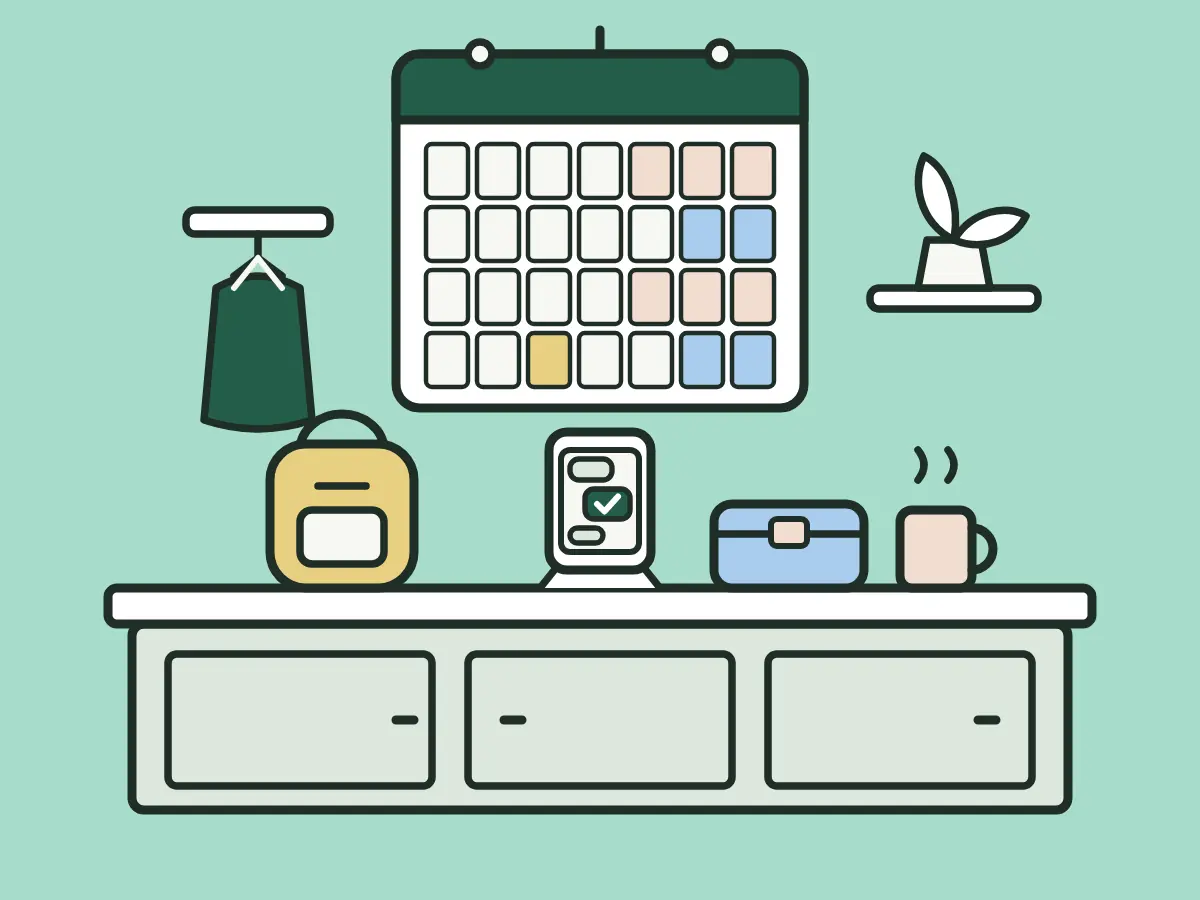
A co-parenting calendar works when both parents see the same plan for the children and nothing else. Build it in layers, starting with the regular pattern and every handover, each with a time and a place. The school holidays go on top of that, and the children's own events go on last. Keep your personal and work plans off it, and agree that no change is final until the other parent says yes.
What a co-parenting calendar is for
A co-parenting calendar (some people call it a custody calendar) is one place where both parents can see where the children are each day and when they move between homes. Its job is to stop the plan living in two heads and a long chat.
Children need it as much as the adults do. Cafcass, which advises the family courts in England, says in its guide to planning your child's time with both parents that children "cope best with predictable and regular routines", and that if they don't know when they're next seeing their other parent, they're likely to worry.
Few families write their plan down. In the Department for Work and Pensions' Survey of Separated Parents (published July 2022), 56% of parents who gave or received help with the children's care, such as overnight stays or school pick-ups, had no agreement about it. Where there was one, it was usually verbal.
Only 9% had it in writing.
That was the figure for both resident and non-resident parents in the same survey. A shared calendar is the simplest way to write your plan down without drawing up anything formal.
I've co-parented my two sons with their mum for about eight years. We get on, and we talk mostly on WhatsApp, plus a quick chat when I collect or drop off. Even so, the plan didn't always stay straight.
What went wrong for us before
Before everything lived in one place, we kept track with WhatsApp messages, and each of us kept our own phone calendar. We also tried a basic co-parenting app, the kind with adverts.
A plan we'd agreed weeks earlier would get buried in WhatsApp, or a change was mentioned but never clearly agreed. The basic app didn't help, because it came with adverts and clutter.

The boys' mum needed whatever we used to be simple: it only works if it's no harder than WhatsApp. That's a good test for any family. If the calendar takes more effort than sending a message, the messages win and the calendar goes stale.
Start with the regular pattern
My one piece of advice is pattern first. Put the regular weekends in before anything else, then add everything else on top of them. Every other entry on the calendar is an exception to the pattern, so you can't see the exceptions clearly until the pattern is there.

Ours is every other weekend, from Friday after school to Sunday afternoon. For the first three or four years it also had a Thursday overnight, which we dropped because of the hour's drive on a school night. If your pattern changes like that, change it on the calendar from a set date, so the old weeks stay as they were.
Set the pattern up as one repeating entry rather than typing in dozens of separate weekends. A repeating pattern runs months ahead without anyone touching it, and it means a missed entry can't quietly become a missed weekend. If you haven't settled on a pattern yet, the guide to how an every other weekend schedule works and the one on typical child contact arrangements cover the common options.
Some families have more than one pattern to fit together. My wife Amy has two children of her own, so our house runs two arrangements across three homes, and we've lined the weekends up. That's far easier when both patterns sit on one calendar you can see at a glance.
Add every handover
The pattern says whose day it is, and the handover entry says how the children get from one home to the other. On a busy Friday, the handover is the part that goes wrong. For each changeover, write down:
- the day and the time
- the place, such as the school gate or the other parent's door
- who does the pickup or the drop-off
Our early handovers were at each other's door, or from school. What helped the boys most was the same times every time. Once a handover time is on the calendar, it becomes the default, and you only talk about it when something has to move.
Write handovers the same way every time.
Pick one format and stick to it, such as this made-up example: "Handover: school gate, 15:15, Alex collects". Anyone glancing at the calendar, including a grandparent doing a pickup, can read it without asking.
If handovers themselves are the hard part in your family, the guide to making handovers easier for children goes into what to pack and how to keep the moment calm.
Put the regular weekends in before anything else, then add everything else on top of them.
George Pritchard
Put the holidays on top
School holidays usually run on a different plan from term time. Cafcass suggests separate routines for term time and holiday time for school-age children. The holidays go on the calendar as a layer over the pattern, and where they overlap, the holiday plan wins.
Start from your council's or school's term dates, then add who has each half term and which weeks of the summer. In our house I have roughly a quarter of the school holidays. Around half terms that usually means a long weekend, and sometimes a full week. In the summer I have my usual weekends plus another one to two weeks, depending on work. Add the special days in the same pass. Cafcass mentions special days such as birthdays and festivals, and says it's good to agree and arrange these "well ahead of time".
The school holidays guide has ways to split half terms and the summer, and there's a separate guide to sharing Christmas. To see what your pattern and holidays add up to over a year, try the parenting time calculator.
Then the children's events
The last layer is the children's own life. That usually means:
- clubs and activities
- birthday parties
- school plays and parents' evenings
- dentist and doctor appointments
These matter to every home even when they fall in one parent's time. The other parent may want to come, or may need to know the football kit has to travel on Friday.
Agree who adds what: the parent who books something adds it. For invitations and school letters, "whoever hears first" is usually the fairest rule, because it stops either of you being the one who always does it. The checklist further down has a table for this.
What to keep off it
Our rule is simple: the family calendar only has events for the boys, nothing personal or work that is shared.
Keeping it narrow makes it easier to use. When every entry is about the children, both parents can read it without wondering what they're being told, and nobody has to think twice before adding something. It also keeps a new partner's life private unless the children are part of the plan.

Keep comments off it too. "Pickup 15:15" tells the other parent a fact, while "Pickup 15:15, please be on time this week" is a message, and it reads worse every time someone opens the calendar. Keep notes to what the children need, like medicine or a lift to a party. The guide to co-parenting boundaries covers the wider question of what each home shares.
If you're worried about the other parent knowing where you are or where you live because you don't feel safe, don't put those details on a shared calendar. You can talk to the National Domestic Abuse Helpline for free, 24 hours a day, on 0808 2000 247. In an emergency, call 999.
The family calendar only has events for the boys, nothing personal or work that is shared.
George Pritchard
How far ahead to add things
The pattern looks after itself once it repeats. Everything else needs adding, and the earlier the better, because a date on the calendar is much harder to clash with than a date in someone's head.
We put holidays in three to six months ahead. Weddings and other big family events go on as soon as the invite lands, often longer ahead than that. Smaller things, like a party or a dentist appointment, go in as soon as you know about them.

Cafcass also notes that a holiday away needs extra planning time. If you're taking the children abroad, put the dates on the calendar as soon as you've agreed them, and share the travel details separately.
How a change gets agreed
Plans change, and a calendar that can't handle changes gets abandoned. The rule we keep is that no swap is final until the other parent says yes. That rule fixes the "mentioned but never agreed" problem, because a change is either agreed or it isn't, and until it is, the original plan stands.
Cafcass puts it plainly: have some flexibility, "but do not make changes without consulting your child's other parent." In practice that means three steps:
- Ask in one place, and say exactly which day and what changes.
- Get a clear yes or no. "Maybe" or a thumbs-up on a long message doesn't count.
- Once it's a yes, the parent who asked updates the calendar.

Agree how quickly you'll each reply, too. A request that sits unanswered for a week is almost as bad as one that was never made. For same-day problems, like a late train or a poorly child, phone first and update the calendar afterwards.
Choosing a tool
There are three common ways to keep a co-parenting calendar, and each has a trade-off.
A shared Google or Apple calendar is free and already on most phones. It sits next to your personal diary, so make a separate calendar just for the children or it's easy to share more than you meant to. Anyone you give editing rights to can also change an event without the other parent agreeing first.
Mixed phones need more thought. Apple's guide to sharing iCloud calendars says you can share one "with other iCloud users". Anyone else can only get a read-only version "that anyone can view but not change". Google Calendar is the easier choice across both kinds of phone, and a shared calendar can be set up from the Google Calendar app on an iPhone. In our family one of us is on an iPhone and the other on Android, and a shared phone calendar never worked for us.
A paper wall planner needs no accounts, and the children can see it in the kitchen. But it lives in one home, so the other home needs its own copy kept in step by hand, and a change made on one never reaches the other.

A dedicated co-parenting app is built for separated families, usually with a repeating pattern and a way to ask for changes. It costs money, and both parents have to sign up. The University of East Anglia's guide to co-parenting apps says the apps it looks at cost "around £100 per year", and that in most cases each parent pays. One I tried made me watch adverts.
The apps I tried didn't click with how we wanted to co-parent, so I built Two Front Doors. The family plans are shared with every home, and anything you mark "Only me" stays private to you. It works on iPhone, Android and the web, so it doesn't matter who has which phone.
Whatever you pick, use the WhatsApp test. If it's harder than sending a message, one of you will stop using it.
Free set-up checklist
The checklist is one A4 page you can fill in together, or one each, before you start. It walks through what to add first and who adds what. There's also space to write down what you're both keeping off and how a change gets agreed. There's an "agreed on" line at the bottom for you both to sign and date, and a date to look at it again.

Download the co-parenting calendar set-up checklist (PDF, A4)
If you'd like something more formal, Cafcass has a tool called Our Child's Plan (it used to be the Parenting Plan), which you can fill in online or as a Word document. It covers the bigger questions, such as where the children live and how you'll keep in touch, and the calendar is where you keep the dates that come out of it.
Questions parents ask
What should go on a co-parenting calendar?
Start with the regular pattern and every handover, with a time and a place for each. Then add the school holidays and special days, and last of all the children's own events, such as clubs and appointments. Leave your work diary and personal plans off it.
Can we just use a shared Google Calendar?
Yes, and it's free. Make a separate calendar just for the children rather than sharing your main one, so your own events stay private. Be aware that anyone with editing rights can change an event without the other parent agreeing first, so agree a rule for changes as well.
Does a shared calendar work if one parent has an iPhone and the other has Android?
It can. A shared Google calendar is the usual choice, because the Google Calendar app runs on iPhone as well as Android. iCloud is harder, because Apple shares calendars for editing with other iCloud users. In our family, with one iPhone and one Android phone, a shared phone calendar never worked for us.
Should the other parent see my personal plans?
No. A co-parenting calendar works best when it only holds plans that involve the children. Your own social life and work can stay off it, and so can a new partner's plans unless the children are part of them.
How far ahead should we plan the school holidays?
We plan ours three to six months ahead, and add weddings and big family events as soon as the invitation arrives. Cafcass advises agreeing special days such as birthdays well ahead of time, and allowing extra planning time for a holiday away.
What if the other parent won't use the calendar?
Keep it yourself, and send the dates you've agreed in writing so there's one clear version. Make it as easy as possible to read, even a paper copy for the other home, and see the guide to co-parenting without an app for more options. If you can't agree the arrangements at all, GOV.UK's guide to making child arrangements if you divorce or separate explains the next steps, starting with mediation.
Sources
- Cafcass, Planning your child's time with both parents after separation
- Cafcass, How an 'Our Child's Plan' (formerly 'Parenting Plan') can help
- Department for Work and Pensions, Survey of Separated Parents, research report 1015 (published 14 July 2022, fieldwork February to March 2021)
- Apple Support, Share iCloud calendars on iPhone (iPhone User Guide, iOS 26)
- Google Calendar Help, Share your calendar (iPhone and iPad)
- University of East Anglia, Co-parenting apps
- GOV.UK, Making child arrangements if you divorce or separate
- Refuge, National Domestic Abuse Helpline