Short answer
In co-parenting, separated parents talk regularly, agree plans together and stay flexible. In parallel parenting, they keep contact to a minimum and follow a detailed written plan, with each parent running their own home their own way. That can calm things down when every conversation turns into a row. Neither is better in every family. The right one depends on whether the two of you can talk without the children feeling the tension.
What parallel parenting means
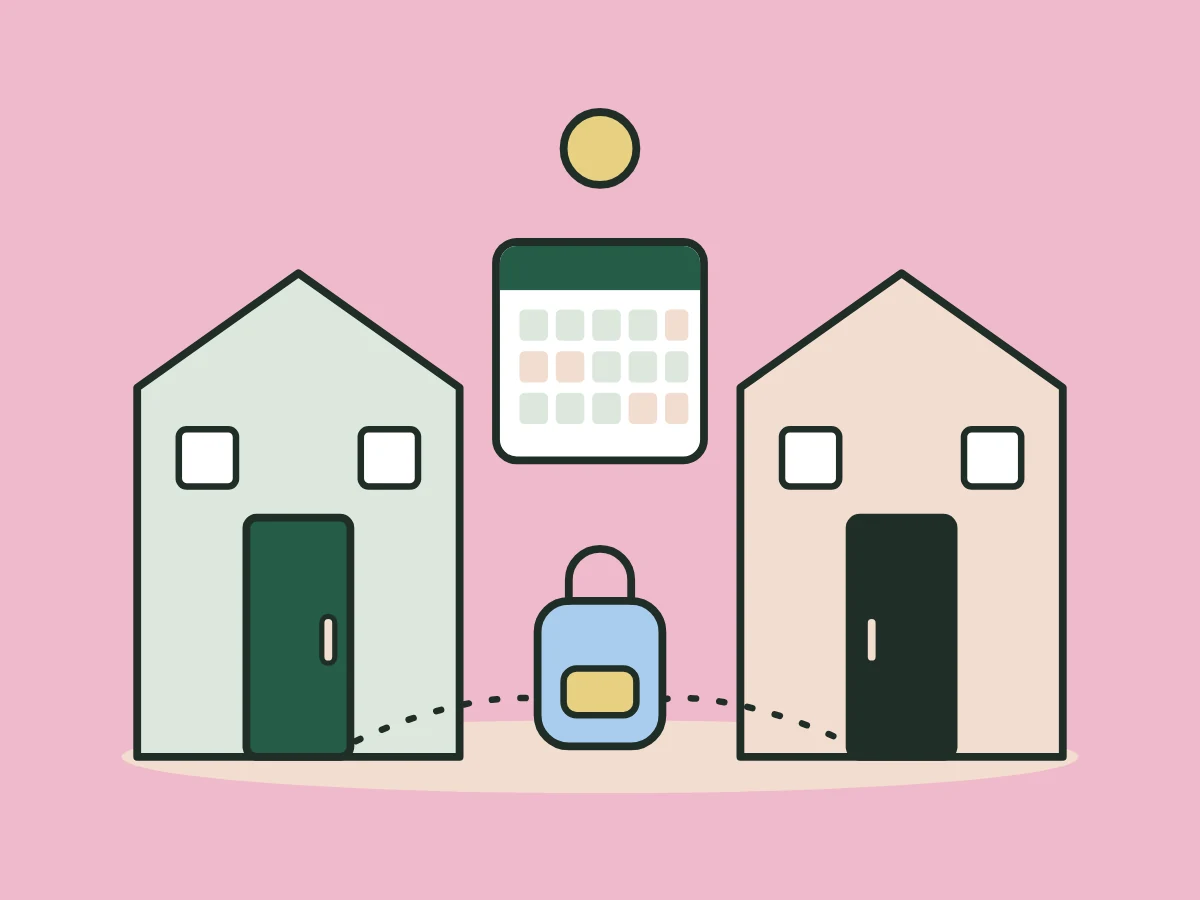
Parallel parenting is a way of sharing the care of your children while having as little to do with each other as possible. Each parent makes the everyday decisions in their own home without checking with the other. Contact between the adults is kept to logistics, and a written plan does the work that conversations would otherwise do.
Think of two lines running side by side towards the same place, the children's wellbeing, without crossing. You don't have to agree on bedtimes or screen time. You only have to stick to the plan and keep the children out of whatever is going on between you.
Both parents stay fully involved with the children, which is what separates it from one parent stepping back. The only thing that shrinks is the contact between the adults.
How the two compare
Co-parenting is what most people picture when they think of separated parents getting it right. You agree things together and swap a weekend when work gets in the way, and the children see the two of you being reasonable with each other. I wrote about what that looks like in an ordinary week in what co-parenting means day to day.
Parallel parenting gives up most of that flexibility in exchange for fewer chances to clash.

The difference is mostly about how much the two homes talk. Both approaches can share time 50/50 or use every other weekend, and both can work well for children. What matters most for the children is the conflict. A 2016 review for the Early Intervention Foundation, What works to enhance inter-parental relationships, found that frequent, intense and unresolved conflict between parents puts children's mental health at risk. So a calm parallel arrangement is likely to serve a child better than a "co-parenting" one where every handover ends in raised voices.
Where the idea comes from
The name most associated with the term is Philip Stahl, a US psychologist and child custody evaluator. In his book Parenting After Divorce and articles such as "Parallel Parenting for High Conflict Families", he described parallel parenting as an option for parents in high conflict: each parent takes charge of their own time with the children, and the parents disengage from each other so the children aren't caught in the middle.
The pattern itself was spotted earlier. Eleanor Maccoby and Robert Mnookin followed more than 1,100 families who filed for divorce in two California counties in 1984 and 1985, and wrote up what they found in their book Dividing the Child. They found three broad styles: parents who cooperated, parents who stayed in conflict, and parents who disengaged and ran their homes separately, which is parallel parenting by another name. A review for the Department of Justice Canada summarises their finding that about a quarter of families were still highly conflicted three and a half years after separating, and that conflicted parents rarely became cooperative over that period.
Closer to home, the Department for Work and Pensions' Survey of Separated Parents found that 28% of separated parents in Great Britain had no contact at all with the other parent. Some of those families are parallel parenting, whether or not they'd use the name.

Doing what's best for the children is the most important thing, and it's worth staying civil even when it's difficult.
George Pritchard
Signs that parallel parenting might help
Most separations involve arguments, especially in the first year. Cafcass, which advises the family courts in England, says ordinary post-separation conflict usually reduces in intensity and frequency over time. What it calls harmful conflict is different: intense from the start, and not easing.
Cafcass lists the signs it looks for:
- a high degree of mistrust between the parents
- difficulty managing hurt and anger
- a sense that things could get out of control
- ongoing difficulty communicating and cooperating
That's the kind of situation Philip Stahl had in mind: if it describes yours, and especially if the children are seeing it, stepping back from each other can help. Cafcass is clear that exposure to this kind of conflict can be emotionally harmful to children, and that the harm can build up if it carries on through their childhood.

Parallel parenting can also suit parents who simply have very different styles and keep clashing over them. If every weekend ends with a debate about bedtimes, agreeing to let each home run its own way can take a lot of heat out of things.
What parallel parenting looks like day to day
Because you aren't going to talk things through, the written plan has to answer the questions before they come up. A good parallel parenting plan usually spells out:
- the regular schedule, with exact handover times and places
- who has the children for each school holiday, Christmas and birthdays
- how handovers happen, ideally without the parents meeting
- how you'll contact each other, and what counts as urgent
- which decisions each parent makes alone and which need both of you, usually things like schooling, medical treatment and moving house
- what happens when one of you wants to change something

Communication moves to one written channel and stays brief, covering dates, times and appointments. Many parents use a shared calendar or a co-parenting app for this, so the plan sits in one place and nobody has to rely on a message buried in a thread.
Handovers are arranged so the adults don't have to meet. School is the easiest version: one parent drops off in the morning and the other collects at the end of the day. Where that isn't possible, some families use a grandparent's house or meet briefly at the kerb.
Each home sets its own rules. That can feel uncomfortable at first, but children already live with different rules at school and at their grandparents' house, so two homes doing things differently is often less strange to them than it feels to the adults.
The downsides
Parallel parenting is a tool for a difficult situation, and it has costs.
The first cost is flexibility. When everything runs through a written plan, a swap for a birthday party or a work trip becomes a formal request instead of a quick text. If one parent won't agree to anything outside the plan, the children can miss out.
The children can end up living by two quite different sets of rules, with no one comparing notes on what's working. For a child who struggles with change, or who needs consistent care, that gap can matter a great deal.
Some things also need a proper conversation. A worry about a child's mental health or a problem at school is hard to deal with through short, logistical messages.

Some professionals see parallel parenting as a stage for exactly these reasons. Edward Kruk, a professor of social work at the University of British Columbia, describes it in Psychology Today as a way to protect children while trust is rebuilt, which can move towards cooperative co-parenting over time.
Why we've always co-parented
I've co-parented for eight years, and parallel parenting was never really an option for us. One of my children has additional needs, so staying in contact with their mum has been essential from the very start.
How we communicate has hardly changed in all that time. Most of it is WhatsApp messages, plus a quick chat when I collect or drop off the children. We try to keep the rules and the children's diet similar in both homes. There are always slight differences in every home, and communication between everyone helps with the adjustments.
Handovers have changed as the children have got older. For years they always meant seeing each other in person, at every pickup and drop-off. Now I often collect them from school, and when I take them back they just run in. Every so often we'll meet at drop-off, or at school to swap things over.

I know we've been lucky. We haven't had arguments, and when something's come up, we've sorted it out amicably. I'm sure both approaches can work. I've always aimed for friendly and civil, but it depends on everyone's relationships, and every family will be different.
Moving from one to the other
Arrangements can change, but slowly. Maccoby and Mnookin found that parents in high conflict rarely became cooperative within three years, which is one reason parallel parenting exists: it gives a family something workable in the meantime.
I've always aimed for friendly and civil, but it depends on everyone's relationships, and every family will be different.
George Pritchard
If you're parallel parenting now, you don't have to stay there. Small steps can rebuild trust:
- a short, polite message about something that went well at school
- a handover that runs on time with no comment either way
- agreeing one swap without a fuss
Trust tends to come back through things going right, more than through big conversations.
It works the other way too. If co-parenting keeps tipping into arguments, it's fine to agree to step back for a while. Saying "let's keep it to the plan and keep messages to logistics for a few months" is a reasonable thing to suggest, and you can review it later.
Agree how you'll talk as well as when the children move.
Write down which channel you'll use for anything about the children and what counts as urgent, so neither of you is left guessing whether a message needs an answer tonight.
When neither approach is safe
Parallel parenting is designed for conflict that both parents are caught up in. Cafcass draws a clear line between that and domestic abuse: harmful conflict is the responsibility of both parents, while abuse is not. If you're frightened of the other parent, or the children are, a parenting style isn't the answer.
In the UK, the National Domestic Abuse Helpline is free and open 24 hours a day on 0808 2000 247. In an emergency, call 999.
If every conversation turns into an argument
This is a hard one, and I won't pretend I have the answer, because it isn't something I've had to deal with. Some people are very difficult to build any kind of working relationship with, however hard you try.
What I can say is that doing what's best for the children is the most important thing, and that it's worth staying civil even when it's difficult. If talking keeps going wrong, try putting everything in writing and keeping it to logistics for a while, and see whether things settle.
If they don't, family mediation is the next step. An accredited mediator can help you agree a plan without going to court, and you don't even have to be in the same room: the Family Mediation Council says mediators can work with you in separate spaces. If you need more help with the situation itself, Family Lives has free advice on shared parenting and contact, and if your child is disabled, Contact supports families with disabled children.
Whichever approach you end up with, put the plan somewhere you both look. In Two Front Doors, a change only happens once the other parent accepts it, which suits co-parents and parallel parents alike.
Sources
- Harold, Acquah, Sellers and Chowdry, What works to enhance inter-parental relationships and improve outcomes for children, Early Intervention Foundation for DWP (2016)
- Philip Stahl, Writings (Parenting After Divorce)
- Stanford Child Custody Study: Family, 1984-1990 (Sociometrics data archive)
- Family Lives, Shared parenting and contact
- Contact, the charity for families with disabled children
- Philip Stahl, Parenting After Divorce: A Guide to Resolving Conflicts and Meeting Your Children's Needs
- Maccoby and Mnookin, Dividing the Child: Social and Legal Dilemmas of Custody, Harvard University Press (1992)
- Department of Justice Canada, High-Conflict Separation and Divorce: Options for Consideration (2004)
- Department for Work and Pensions, Survey of Separated Parents: summary (published 14 July 2022)
- Cafcass, Harmful conflict
- Edward Kruk, Parallel Parenting After Divorce, Psychology Today (2013)
- Family Mediation Council, Family mediation
- National Domestic Abuse Helpline (Refuge)